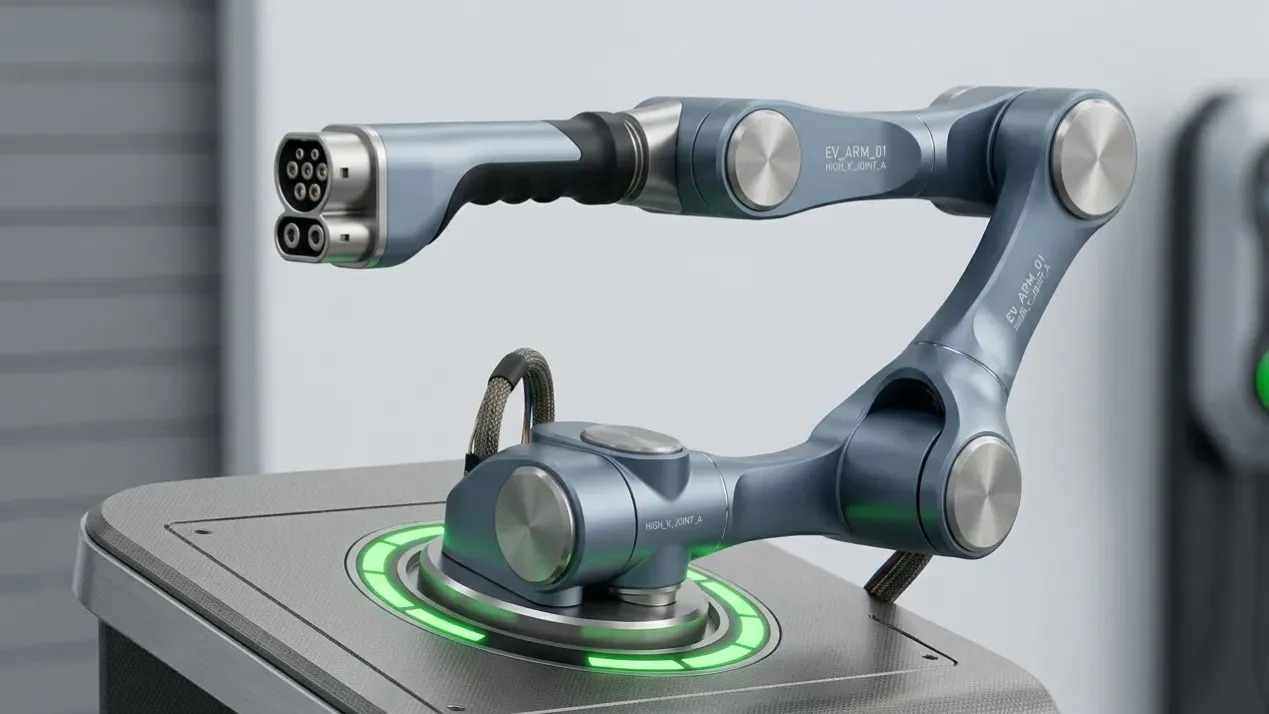
BYD (HKG: 1211) has published a patent for a fully unattended robotic system that autonomously handles the entire charging cycle for new energy vehicles and simultaneously monitors and inflates tires — without requiring any modification to the vehicle.
The patent, titled "A Robot" and formally described as a vehicle automatic charging and inflation robot, was filed with China's National Intellectual Property Administration (CNIPA) on March 24, 2025, and is currently under review.
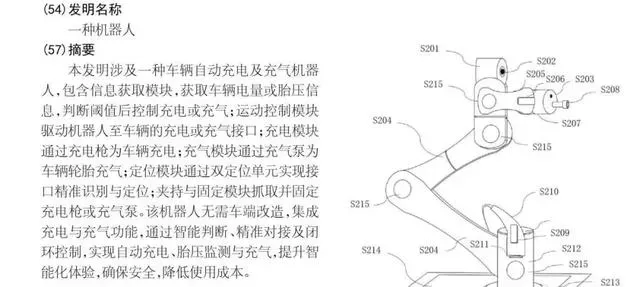
BYD robotic charging arm patent (CNIPA)
The design integrates six functional modules into a single unit: an information acquisition module that reads the vehicle's battery level and tire pressure, a motion control module that drives the robot to the correct interface, a charging module delivering power via a charging gun, an inflation module operating a pneumatic pump, a dual-unit positioning module for precise port identification, and a gripper-and-fixation module that grasps and holds the charging gun or inflation nozzle during operation.
Advertisement – Continue scrolling for more
Once a vehicle parks at a compatible bay, the system autonomously checks battery charge state and all four tire pressures against set thresholds, then sequences the appropriate service operations without human intervention. The closed-loop control architecture means the robot self-verifies each step — approach, alignment, connection, service delivery, and disconnection — before proceeding to the next.
A critical design condition stated in the patent abstract is that no vehicle-side hardware modification is required for operation, meaning the system is intended to work with existing NEV charging port designs. No production timeline or deployment plans have been disclosed alongside the patent publication.
The filing arrives as a competitive race for automated charging has accelerated sharply across the Chinese market. Li Auto (NYSE: LI), in partnership with Chang Guang Xi Intelligent Manufacturing (CGXi), unveiled what it calls the world's first one-to-many rail-mounted robotic charging arm, confirmed by CEO Li Xiang at the Li i8 launch event in July 2025.
Advertisement – Continue scrolling for more
The system travels along an overhead sled-style rail, uses 3D vision guidance and compliant force-control technology to identify the charging port, and completes the connection in under 0.6 seconds with millimeter-level insertion accuracy, according to Chinese automotive media reports.
Li Auto plans to open its first commercial automated charging stations in Q2 2026, deploying the technology within its existing 5C fast-charging network, which stood at over 4,000 stations with more than 22,000 individual charging piles as of Q1 2026.
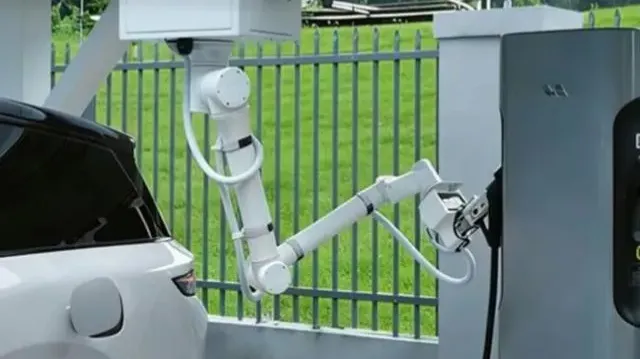
Li Auto robotic charging arm (Li Auto)
Huawei's robotic arm charger — equipped with high-definition cameras and a radar system — has already been deployed across eight Chinese cities and is compatible with all brands within the Huawei Supercharging Alliance, including XPeng, BYD, and Aito.
Zeekr demonstrated a robot capable of identifying port position and completing plug-in autonomously, paired with its V3 ultra-fast charging piles at up to 800 kW output. BMW completed a proof-of-concept for an automated charging robot that performs path planning, plug-in, and disconnection with no user involvement.
Advertisement – Continue scrolling for more
The commercial rationale for robotic charging in China is structural, not incidental. China's installed charging connector base surpassed 20 million units as of December 2025, but older residential complexes and multi-storey parking structures remain difficult to retrofit with fixed installations.
Robotic systems eliminate the per-space electrical connection requirement and are particularly suited to the "tidal" demand patterns where peak-hour use concentrates in a fraction of available bays.
China's mobile charging robot market was valued at approximately 400 million CNY (c. $58 million) in 2024, with one industry projection estimating growth to 65 billion CNY (c. $9.4 billion) by 2027 and 180 billion CNY (c. $26 billion) by 2030, driven by the continued rise in NEV penetration and the replacement cycle of early-generation EVs among private owners.
CATL's (HKG: 3750) subsidiary CharGo is pursuing a parallel mobile charging robot strategy, with its CEO projecting robotic systems could handle up to 20 percent of NEV charging in China by 2030.
Advertisement – Continue scrolling for more
According to Electrek, Beijing authorities plan to deploy 1,000 mobile charging robots across 150 parking facilities, while global mobile charging robot revenue is projected to grow from $81 million in 2025 to $300.9 million by 2034.
What separates BYD's patent from the approaches taken by Huawei, Li Auto, Zeekr, and BMW is the integration of vehicle maintenance — tire pressure monitoring and inflation — into the same robotic service cycle.
Whether this multi-function architecture reaches production, and whether the no-vehicle-modification requirement holds across the full diversity of port positions across different NEV models, will determine if the patent translates into a deployable product or remains a reserved technology position as the wider sector scales.
Advertisement – Continue scrolling for more