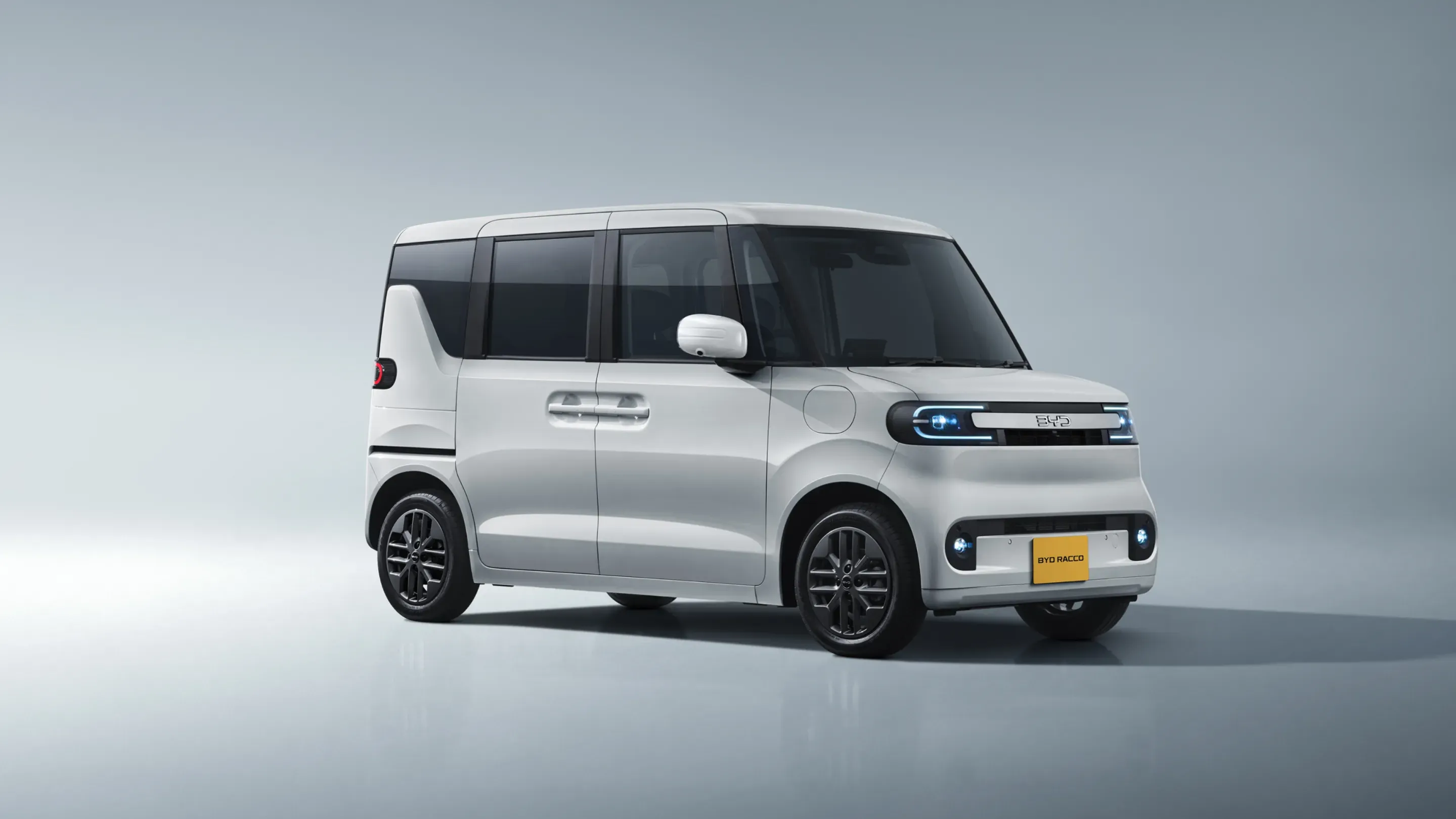
BYD (HKG: 1211) locked in more than 5,000 paid deposits for its Racco electric kei car in the first week after Japanese presales opened, according to Chinese outlet Yiche. The figure, reported July 30, 2026, arrives two days after BYD's July 28, 2026 launch of the Racco in Japan and puts the automaker roughly halfway toward the 10,000-unit annual sales target it set for the model's debut year.
At the Racco's prototype debut during the 2025 Tokyo Motor Show in October 2025, the concept had already drawn roughly 30,000 non-binding expressions of interest, Yiche reported, well ahead of its confirmation as a production vehicle available to Japanese buyers.
The Racco is BYD's first kei car and its first model built specifically for Japan's light-vehicle segment, which accounts for nearly 40% of the country's new-vehicle sales. Toyota's Suzuki and Daihatsu units, together with Honda (TYO: 7267), control about 80% of that market, according to Bloomberg Intelligence. BYD hired a former Nissan (TYO: 7201) kei-car executive to help develop the project.
Advertisement – Continue scrolling for more
The Racco's chassis is built on BYD's e-Platform 3.0 and uses Cell-to-Body (CTB) construction, integrating the automaker's lithium iron phosphate Blade battery into the vehicle structure. BYD Japan developed a new modular unit called X-PACK specifically for the model, folding the battery, electronic control unit, DC/OBC unit, high-voltage distribution unit and vehicle control unit into a single housing to free up crush space. The body uses roughly 70% high-strength steel, with the roof and side panels laser-welded rather than spot-welded, a method BYD Japan says preserves rigidity despite the tall body and sliding-door cutouts.
BYD said the Blade battery has passed nail-penetration and multi-cell short-circuit thermal-runaway tests without fire or explosion, and that it stayed below 40°C in a 1,000-joule impact test. The Racco's single front motor produces 47 kW (63 hp) and 160 Nm of torque across all three trims, with maximum DC fast-charging capped at 50 kW — on par with the Honda N-ONE e: despite the Racco's larger battery in higher trims.
Advertisement – Continue scrolling for more
Two battery options are offered. The entry-level Racco 200 uses a 22.4 kWh LFP pack for a WLTC range of 210 km (130 miles). The 300 Plus and 300 Premium trims step up to a 35.84 kWh pack rated at 320 km (199 miles) WLTC, which BYD says makes the Racco the first kei EV in Japan to exceed 300 km on that test cycle. Curb weight ranges from 1,160 kg for the base trim to 1,230 kg for the top Premium grade.
Built to Japan's kei-car size limits, the Racco measures 3,395 mm long, 1,475 mm wide and 1,800 mm tall on a 2,520 mm wheelbase, using a "Super Tall" body with power sliding doors on both sides — Japan's first kei EV with that feature — that open via a kick sensor. Folding the rear seats opens up to 1,372 liters of cargo space. Standard equipment includes a 10.1-inch center touchscreen, Level 2 driver-assistance, vehicle-to-load power output, heated front seats and steering wheel, six airbags, an NFC phone key, battery preconditioning and tire-pressure monitoring. Six exterior colors are offered, with Gem Red and a black-and-beige synthetic-leather interior reserved for the range-topping 300 Premium.
Advertisement – Continue scrolling for more
Tax-included manufacturer prices run from ¥2,145,000 (c. $13,100; c. 88,700 CNY) for the Racco 200, to ¥2,398,000 (c. $14,700; c. 99,200 CNY) for the 300 Plus, and ¥2,497,000 (c. $15,300; c. 103,200 CNY) for the 300 Premium. A national CEV subsidy of ¥150,000 (c. $920; c. 6,200 CNY) applies uniformly across the range, bringing the entry grade under ¥2 million (c. $12,200; c. 82,500 CNY) after incentives. BYD Japan is also offering a residual-value loan, the "Racco Rakutto Plan," financed through Jaccs, with payments starting at ¥19,300 (c. $118; c. 800 CNY) per month over 60 installments with no down payment.
The pricing undercuts Nissan's Sakura, currently Japan's best-selling EV, which starts near ¥2,448,600 (c. $15,000; c. 101,200 CNY) and offers only 180 km of range, as well as Honda's N-ONE e:, which starts around ¥2.7 million (c. $16,500; c. 111,600 CNY). Battery coverage on the Racco runs 8 years or 160,000 km at a minimum 70% retained capacity as standard, extendable to 10 years or 200,000 km through a paid upgrade priced at ¥18,000 (c. $110; c. 750 CNY).
Whether the early rush of deposits holds up once buyers cross-shop against Honda's N-BOX — Japan's best-selling vehicle overall, with more than 56,000 units sold in the first quarter of 2026 alone — will say more about BYD's chances in Japan's kei-car market than the opening week's numbers do on their own.
Conversion rates: 1 USD = 163.28 JPY; 1 CNY = 24.18 JPY, as of July 30, 2026
Advertisement – Continue scrolling for more