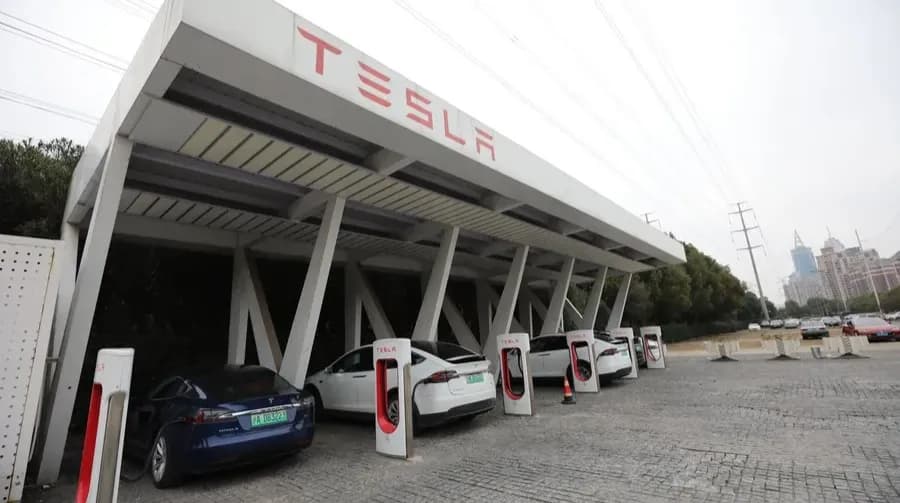
China's National Energy Administration said on July 28, 2026 that the country's electric vehicle charging infrastructure reached 23.057 million points by the end of June 2026, up 43.2% year on year. The figure comes from the National Charging Infrastructure Monitoring Service Platform and covers every public and private charging point installed nationwide.
Public charging points totaled 5.009 million, up 22.3% year on year, with rated total capacity reaching 247 million kilowatts and average output per point at roughly 49.35 kilowatts. Private charging points reached 18.048 million, up 50.4% year on year, with installed private charging capacity totaling 155 million kilovolt-amperes — nearly 3.6 times the public network's point count. Private installations now account for roughly 78% of all charging points nationwide, up from a smaller share a year earlier, underscoring how much of the network's growth is happening behind residential gates and office parking lots rather than at public plazas or highway stops.
Advertisement – Continue scrolling for more
The pace has cooled slightly from earlier in the year. China's charging network stood at 22.497 million points at the end of May 2026, up 44.9% year on year, meaning the network added roughly 560,000 points in June alone even as the year-on-year growth rate edged down by 1.7 percentage points. Private installations remain the primary driver of that expansion, growing faster than the public network in both months.
The buildout has been accelerating for over a year. China's total charging infrastructure reached 20.092 million points by the end of 2025, with the network taking just 18 months to grow from 10 million to 20 million units — a pace the National Energy Administration said could meet the charging demand of more than 40 million new energy vehicles. Average power per public charging point has climbed alongside that expansion, rising from 46.5 kilowatts at the end of 2025 to 48.89 kilowatts at the end of May 2026 and then 49.35 kilowatts by the end of June, a steady shift toward faster charging even as the network's raw point count keeps growing.
Advertisement – Continue scrolling for more
Holiday charging demand set a new record this year. During the May Day holiday, highway charging sessions nationwide totaled 3.9784 million, drawing 94.9314 million kilowatt-hours, with average daily charging volume of 18.9863 million kilowatt-hours — a 14.09% increase over the Spring Festival holiday and the highest figure on record for a holiday period.
High-power charging has also expanded. The National Energy Administration reported more than 180,000 high-power charging points built nationwide by the end of June 2026, part of what it described as an accelerating rollout of a well-distributed, technically advanced fast-charging network. That figure represents less than 4% of the public network's total point count, indicating the fast-charging buildout is still in its early stages relative to the broader public charging footprint. County-level coverage climbed to 98.61% by the end of June, reflecting continued buildout of charging infrastructure in townships and rural areas that had lagged urban centers in prior years.
The July data lands roughly a month after the agency laid out its longer-term target. At a press conference in late June, NEA vice administrator Wan Jinsong said China plans to roughly double its charging infrastructure to 40 million points by 2030, framing charging facilities as one of several new energy infrastructure categories — alongside renewable hydrogen production and virtual power plants — that Beijing intends to accelerate through the 2026-2030 period. Reaching that goal from June's 23.057 million base would require sustained annual growth even as the year-on-year rate has already begun to soften from the 44.9% pace recorded a month earlier.
Advertisement – Continue scrolling for more
The county-level coverage figure carries particular weight for a network built primarily around private installation. Rural and township buyers have historically faced longer waits for grid connections and public charging access than buyers in major cities, and the NEA's emphasis on county coverage alongside the private-charging surge suggests policymakers see home and workplace charging, not additional public stations, as the more efficient route to closing that gap. The private-capacity figure — 155 million kilovolt-amperes of reported electrical load — also points to a parallel strain on local distribution grids that utilities will need to plan around as installation rates continue outpacing the public network.
Private charging's outsized growth rate points to a market increasingly shaped by home and workplace installations rather than public stations, a shift that raises questions about how operators of public networks will compete for utilization once most EV owners can charge without leaving their driveway.
Advertisement – Continue scrolling for more