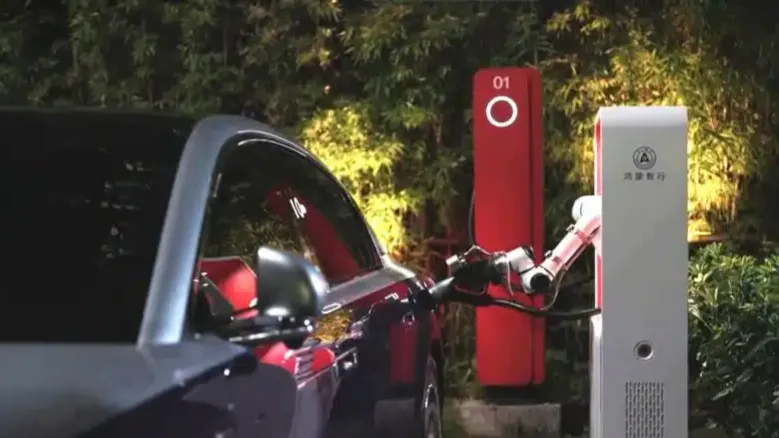
The Maextro S800, a joint venture between Huawei and JAC Motors (SZSE: 000418), has introduced what may be China's most ambitious EV charging solution to date: a fully autonomous robotic arm system that lets the car locate a charging station, park itself, accept the charging connector, and drive away — all without the driver leaving their seat.
Launched on May 30, 2025 and priced from 708,000 CNY (c. $103,900) to 1,018,000 CNY (c. $149,300), the S800 targets China's ultra-luxury sedan segment in direct competition with the Mercedes-Maybach S-Class. At 5,480 mm (215.7 in) long with a 3,370 mm wheelbase — larger than a Maybach S-Class at 5,460 mm — it is configured for four passengers in a dedicated luxury arrangement, and features a 76-inch head-up display and 43-speaker audio system.
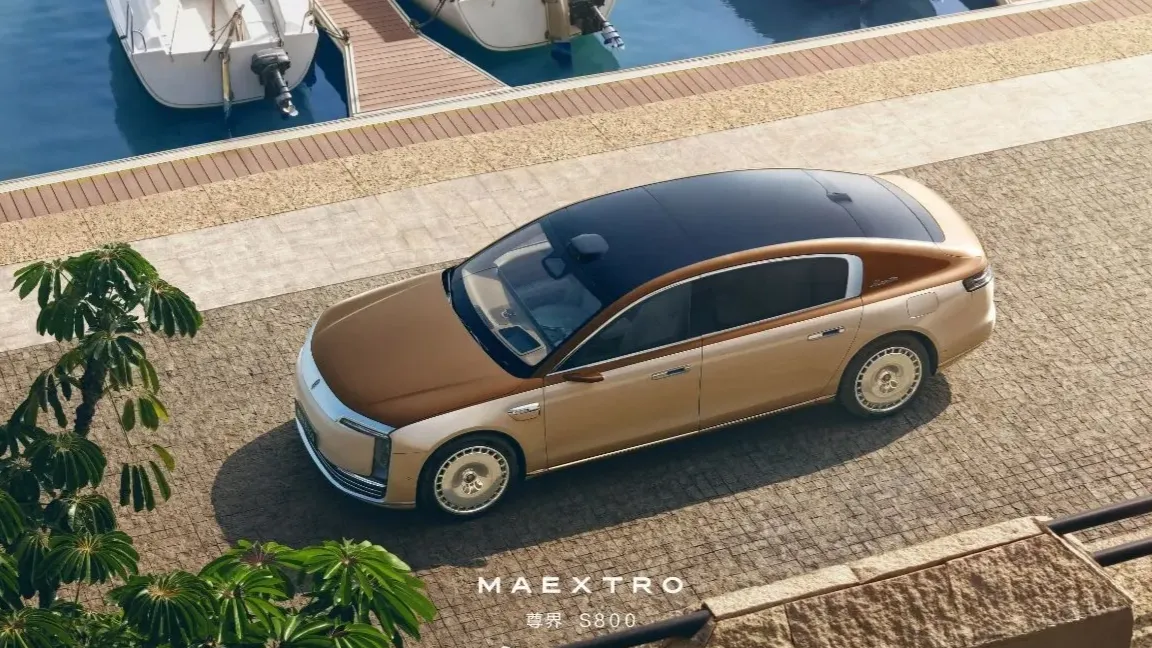
By early 2026, the S800 had accumulated over 15,000 deliveries and outsold rivals from Porsche, BMW, and Maybach in China's above-700,000 CNY segment, cementing Maextro as a commercial force in domestic ultra-luxury.
First demonstrated publicly in January 2025 and branded the "Fusion Perception Charging Robot", the system integrates LiDAR, visual sensors, Huawei-proprietary processing chips, and NearLink short-range wireless communication. When a driver remotely activates the function, the S800 autonomously navigates to an available charging bay, self-parks, and the robotic arm locates the charging port and inserts the connector — monitoring obstacles throughout. After charging completes, the arm retracts, returns the gun to its cradle, and the vehicle drives clear of the bay. The entire sequence requires zero human intervention.
Advertisement – Continue scrolling for more
The arm pairs with Huawei's 600 kW liquid-cooled supercharger, which the company says can add 200 km (124 miles) of range in approximately five minutes. Huawei pushed the envelope further in April 2025, unveiling a 1.5 MW megawatt charger capable of delivering 20 kWh per minute — among the most powerful commercial EV chargers announced globally — with the robotic arm designed to operate on both platforms.
The system extends beyond the Maextro brand. Huawei has built compatibility with all members of its Supercharger Alliance, including BYD (HKG: 1211), Xpeng (NYSE: XPEV), Li Auto (NASDAQ: LI), Aito, JAC, and Great Wall Motor. Mass production of the robotic charging unit began in the second quarter of 2025. A logistics partnership with SF Express and JD.com is deploying the 1.5 MW standard to commercial truck fleets, with more than 5,000 electric vehicles expected to be adapted for the new charger type.
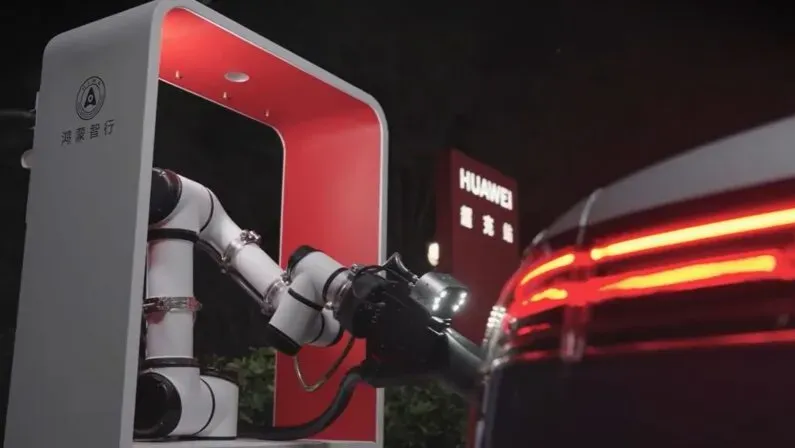
Maextro S800 robotic arm charging (HIMA)
Huawei's robotic arm rollout coincides with intensifying competition across China's charging infrastructure sector. NIO (NYSE: NIO) and CATL (SZSE: 300750) formed a partnership to operate the world's largest battery swap network, with more than 2,700 stations in service.
BYD filed a patent in March 2025 for a fully unattended robotic charger that also handles tire inflation, and is targeting 20,000 megawatt-level flash charging stations by end of 2026. Li Auto, in partnership with Chang Guang Xi Intelligent Manufacturing, has demonstrated a ceiling rail-mounted robotic arm capable of inserting a charging connector in under 0.6 seconds, with its first commercial automated stations planned for Q2 2026. China's mobile charging robot market, valued at approximately 400 million CNY (c. $58.7 million) in 2024, is projected to reach 65 billion CNY by 2027.
Advertisement – Continue scrolling for more
The robotic arm forms a tangible part of Huawei's Qiankun smart car strategy. The S800 was the first mass-produced vehicle to ship with Huawei ADS 4, the company's autonomous driving system now installed across 1.4 million vehicles as of December 2025. Huawei has set a target of equipping 80 models and 3 million vehicles with Qiankun ADS by end of 2026, with ADS 5 and HarmonySpace 6 cockpit software planned for release in April 2026. The Qiankun ecosystem unifies charging, parking, and servicing through a connected app layer — a sign that Huawei is positioning itself as intelligent infrastructure for the broader Chinese EV fleet, rather than a standalone vehicle brand.
Whether Huawei's robotic arm becomes standard-issue across China's charging network, or whether BYD's patents and Li Auto's rail system fracture the market into competing proprietary standards, will depend on who builds the ecosystem densely enough, fast enough, to make a driver's choice of station irrelevant.
Conversion rate: 1 USD = 6.8172 CNY as of April 20, 2026
Advertisement – Continue scrolling for more