
Source: NIO
NIO (NYSE:NIO) began rolling out its Banyan 3.3.0 software update on January 28, 2026, introducing the 2nd version of its NIO World Model (NWM) assisted driving system to more than 460,000 vehicles in China.
The update targets models running NIO’s Banyan platform and represents the largest revision to the company’s assisted driving system since the initial deployment of NWM in mid-2025, following mixed feedback from early users.
Advertisement – Continue scrolling for more
NIO’s assisted driving strategy is built around the World Model architecture, which underpins its NAD (NIO Assisted Driving) system. The first generation of NWM was pushed to Banyan vehicles in July 2025, but owner feedback was broadly cautious, and software iteration slowed in the months that followed. Banyan 3.3.0 marks the first major upgrade since then.
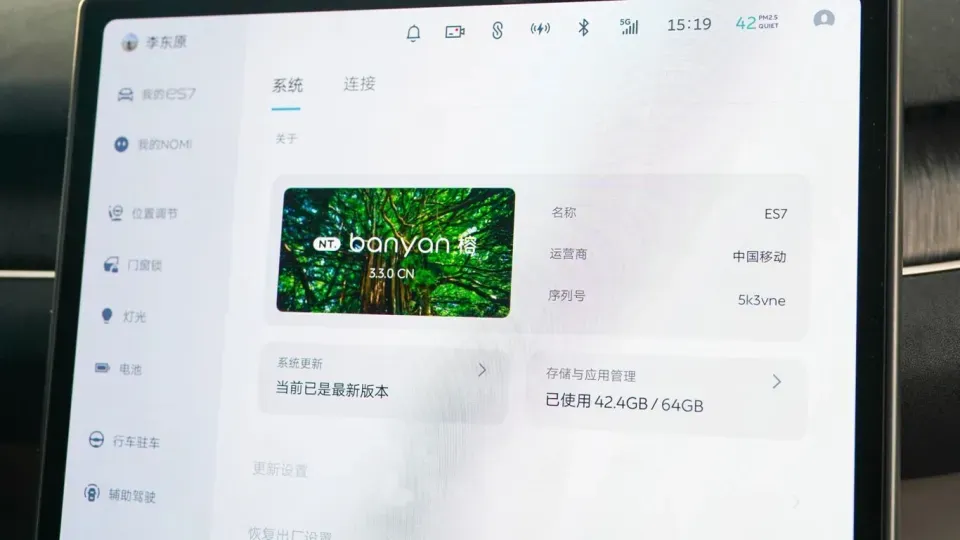
The rollout covers vehicles dating back to the first-generation ET7, which launched in 2021, giving long-time owners access to the latest software stack. These vehicles are equipped with four Orin-X chips, hardware that NIO has previously said was intended to support more advanced assisted driving functions over time.
Vehicles running the Cedar and Cedar S operating systems are not included in the first wave. NIO said these models are undergoing final optimization and will receive update notifications in the near term.
Advertisement – Continue scrolling for more
Early testing of the Banyan 3.3.0 system was conducted on urban roads in Shanghai, including extended city driving using NAD. AutoLab reported that the system’s urban performance had reached the level of leading assisted driving offerings currently available in China, particularly in terms of decision-making consistency and vehicle control.
In city navigation scenarios, the updated system showed improved handling of slow-moving vehicles. When encountering congestion ahead, the vehicle was able to assess surrounding traffic, execute lane changes once conditions were safe, and maintain smooth lateral and longitudinal control during overtaking maneuvers.
Route awareness was also emphasized. In cases where navigation required an upcoming turn, the system opted to remain behind slower traffic rather than overtaking unnecessarily, adjusting position later at intersections in line with the planned route.
Advertisement – Continue scrolling for more
Performance on narrow urban roads remained a focus area. In one test scenario involving an oncoming two-wheeled vehicle, the system initially prepared to pass but quickly revised its decision, steering away and reducing speed without coming to a complete stop. AutoLab noted strong safety margins, though some signaling behavior, such as prolonged use of turn signals on curving roads, appeared inconsistent.
Banyan 3.3.0 also introduces navigation-assisted battery swapping, extending assisted driving functionality into parking facilities and swap stations. Using voice commands via NIO’s in-car assistant, drivers can initiate navigation to a swap station and allow the system to manage entry, queuing, and positioning.
During testing, the system handled speed control through parking gates, automatically queued behind other vehicles when pedestrians were detected, and activated automated parking assistance to enter the swap station. After the battery exchange, drivers could resume navigation without manual repositioning.
Advertisement – Continue scrolling for more
U-turn scenarios in dense traffic were also evaluated. The system demonstrated the ability to follow leading vehicles to establish space, assess cross-traffic conditions, and execute the maneuver once clear. AutoLab noted frequent small steering corrections during the turn, identifying an area for further refinement.
According to NIO, the updated World Model applies a full closed-loop reinforcement learning framework to assisted driving development. The system integrates perception, decision-making, and execution into a continuous feedback loop designed to improve performance in complex environments. The company said the approach enhances urban and highway navigation, intelligent parking assistance, and active safety functions.
Advertisement – Continue scrolling for more
Additional software improvements include more consistent lane selection when following navigation routes, better handling of consecutive intersections, improved traffic flow avoidance, and the introduction of an efficiency-focused lane change function.
NIO has acknowledged that the current version of NWM has not yet reached its full potential due to limitations in available training data. Founder and chief executive Li Bin has previously said the company plans three major assisted driving updates in 2026 and has approved increased cloud computing investment to expand large-scale model training and improve long-tail scenario handling.
Beyond assisted driving, Banyan 3.3.0 also adds practical features such as support for iPhone digital keys, expanding daily usability for existing owners.
Advertisement – Continue scrolling for more