Source: NIO
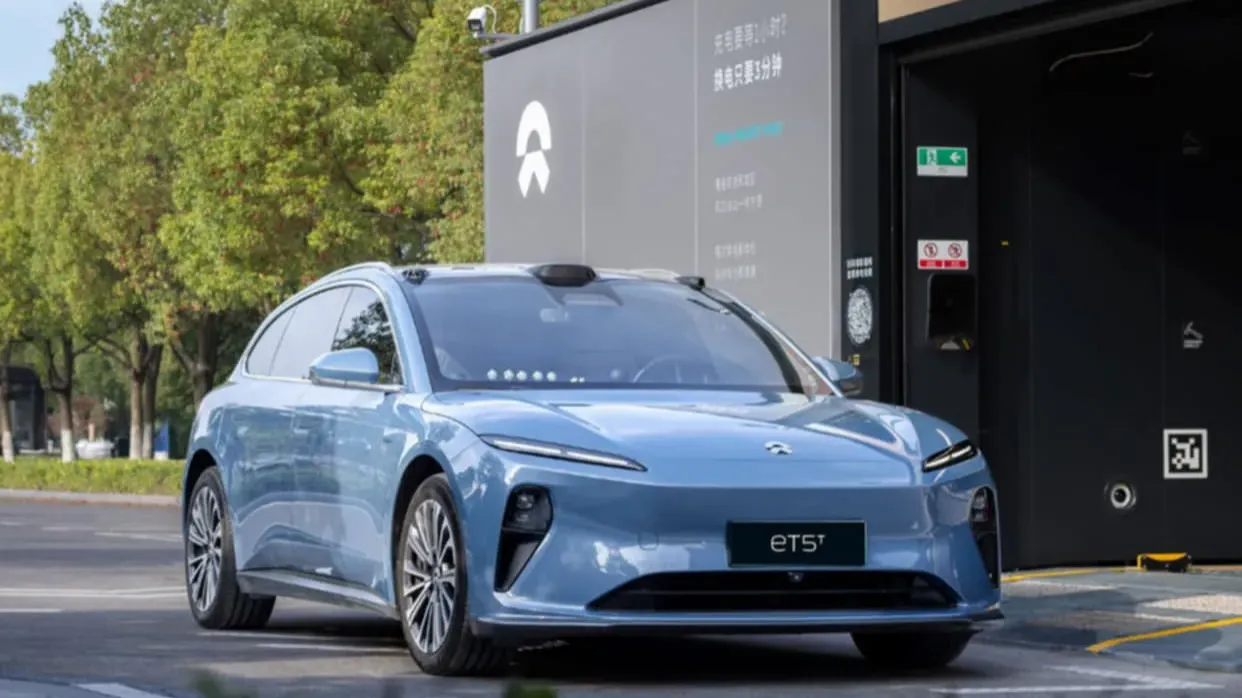
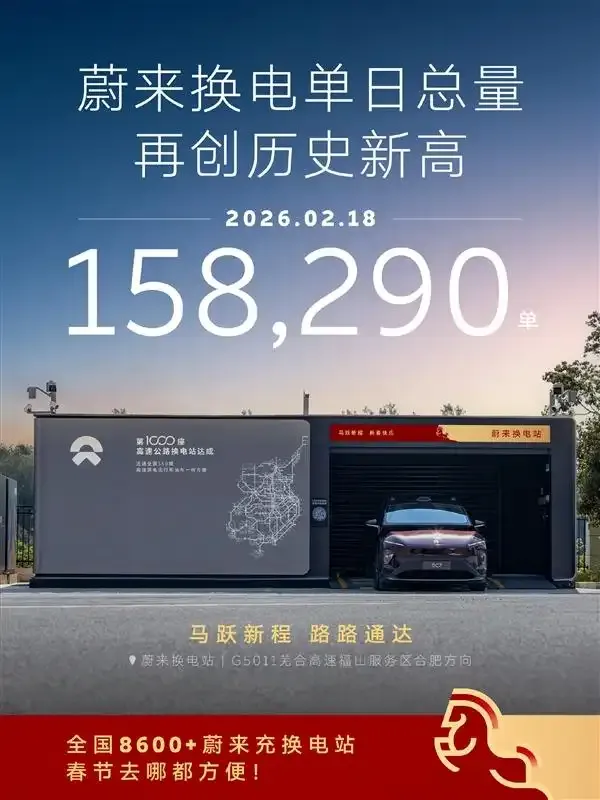
NIO Inc. (NYSE: NIO, HKG: 9866) set a new single-day battery swap record on February 18, 2026 — the second day of China's Lunar New Year — completing 158,290 swaps, its third all-time high in the span of two weeks.
Source: NIO
The figure eclipsed a prior record of 146,649 swaps on February 15, the first day of the Spring Festival holiday — itself set just nine days after the company reached a cumulative total of 100 million battery swaps on February 6. China's Spring Festival, the country's most significant national holiday, generates one of the world's largest annual human migrations as workers return to hometowns across the country.
Advertisement – Continue scrolling for more
The February 18 peak translates to roughly 6,595 swaps per hour, or 110 per minute, across a network operating at full load. The busiest individual station that day was the Toubao Service Area on the G1523 Ningbo-Dongguan Expressway in Fujian Province, which handled 166 swaps. Second was the Longhushan Service Area on the G60 Shanghai-Kunming Expressway in Jiangxi, with 157, followed by the Gaoqiao Service Area on the G70 Fuzhou-Yinchuan Expressway in Fujian with 153.
Each of NIO's fourth-generation swap stations is capable of handling up to 480 swaps per day, with an average service time of approximately two minutes and 24 seconds per vehicle. The stations operate fully automated, with no staff assistance required — a significant departure from first-generation units introduced in 2018 that required manual positioning.
Advertisement – Continue scrolling for more
NIO opened its first swap station in Shenzhen on May 20, 2018, at a time when the model drew widespread industry skepticism. Over the following 11 years, the company invested more than 18 billion CNY (c. $2.6 billion) in charging and swap infrastructure and secured more than 2,100 related patents, including 1,500 specific to battery swapping.
Today, NIO operates 3,750 swap stations nationwide, with 1,022 situated along expressways, embedded in a broader network of more than 8,600 combined charging and swapping facilities. The highway grid covers 550 cities and spans what the company describes as nine north-south corridors, 11 east-west corridors, and 16 major urban clusters — including the G318 Sichuan-Tibet route and county-level coverage across nine provinces. In 2026, NIO plans to add at least 1,000 new swap stations, with fifth-generation stations — which promise lower build costs and broader model compatibility — slated for large-scale deployment.
Advertisement – Continue scrolling for more
The 100 million cumulative swaps have delivered 5.28 billion kWh of electricity, saved users an estimated 83.41 million hours compared with conventional charging — approximately 88 hours per individual user — and reduced cumulative energy costs by more than 26.3 billion CNY (c. $3.8 billion) relative to gasoline refueling. The environmental tally includes a reduction of more than 4,169.5 tonnes of CO₂ emissions, equivalent to the annual carbon absorption of roughly 167,000 trees.
During the Spring Festival period, NIO waived swap service fees for owners of the Ledao sub-brand, deepening user retention as the company targets its first full year of operating profitability in 2026 — following an alert of its first quarterly operating profit in Q4 2025.
Ministry of Transport data released February 16 projected that new energy vehicles would account for roughly 22% of total expressway traffic during the Spring Festival holiday, with a peak-day volume of up to 15.3 million NEVs on the road — a structural tailwind that may test whether swap infrastructure can continue scaling as fast as the fleet that relies on it.
Conversion rate: 1 USD = 6.90 CNY as of February 19, 2026
Advertisement – Continue scrolling for more