Source: Nissan
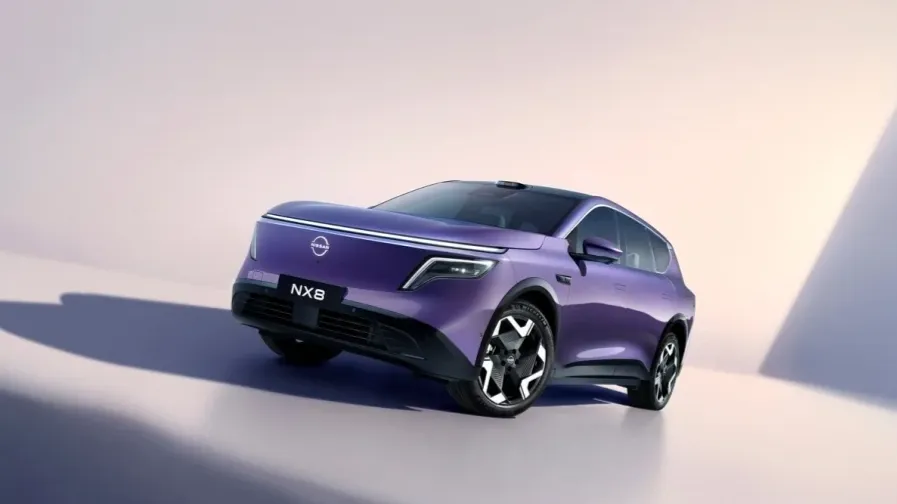
Dongfeng Nissan’s all-new NX8 SUV has appeared in China’s latest Ministry of Industry and Information Technology (MIIT) filings on December 7, 2025, marking a key step in the joint-venture manufacturer’s expansion of its domestic new-energy portfolio. The mid-to-large model is scheduled for market launch in the first half of 2026 and is positioned as a family-focused, long-wheelbase utility vehicle built under Nissan’s Tianyan architecture.

Source: Nissan
The NX8 joins Dongfeng Nissan’s new-energy product plan that includes the N7 electric sedan and N6 plug-in hybrid sedan, forming what the company calls a complete “new-energy family group.” The naming convention reflects a new strategy for the brand’s electrification sequence: “N” for new energy, “X” for a crossover positioning, and “8” to denote its size class.
Advertisement – Continue scrolling for more
The vehicle measures 4,870 mm in length, 1,920 mm in width, and 1,680 mm in height, with a 2,917-mm wheelbase. These dimensions place the NX8 directly in the mid-to-large family SUV bracket, competing against domestic models that emphasize long cabin layouts and extended wheelbases. Dongfeng Nissan is targeting multi-generation household usage patterns, prioritizing rear-seat legroom and interior volume. The NX8 will offer 19-inch and 20-inch wheels and adopts a smooth exterior theme with hidden door handles and simplified surfacing.

Source: Nissan
Design elements include an updated application of Nissan’s V-motion front, a 2.4-meter full-width light bar, and a flat illuminated brand logo. Rear styling incorporates a full-width taillight system containing 2,064 OLED light sources. Filing images indicate split-light headlamp arrangements and blacked-out lower body sections.
Advertisement – Continue scrolling for more
Technical specifications show the NX8 will offer both pure-electric and range-extended variants. The range-extended version combines a 1.5-liter turbocharged range-extender engine rated at 109 kW with a 195-kW drive motor. The pure-electric configuration uses Nissan’s first 800V high-voltage architecture within its joint-venture lineup and is paired with CATL’s LFP “YunDun (Cloud Shield)” battery. Motor outputs listed in filings include 215 kW and 250 kW, depending on variant, with both versions capped at a top speed of 180 km/h (112 miles per hour).

Source: Nissan
CATL supplies the cells, while pack integration is carried out locally under Nissan-global validation standards that exceed Chinese national testing requirements. The system supports operation between –30°C and 60°C, with charging designed to retain 5C ultra-fast-charging capability within this temperature window. The architecture places Dongfeng Nissan among the first joint-venture manufacturers in China to commit a high-voltage, fast-charging SUV to production.
Advertisement – Continue scrolling for more
Intelligent-driving hardware includes lidar and a sensor suite enabling highway and urban Navigation on Autopilot (NOA) as well as all-scenario parking assistance. The company has typically adopted conservative calibrations in its advanced driver-assistance systems, and on-road capability for the NX8 will depend on final software maturity closer to production.

Source: Nissan
In China, joint-venture brands have faced pressure as domestic manufacturers advance in 800V powertrains and city-level NOA deployment. The NX8 is described as a corrective entry into a segment dominated by domestic mid-to-large EVs tailored for family buyers. The model’s emphasis on long cabin space, full-temperature performance, and high-voltage architecture reflects this recalibration of product priorities.
As the NX8 approaches its planned 2026 release, the model becomes a test of how Dongfeng Nissan intends to compete in an increasingly high-specification EV segment, and whether the joint-venture’s shift toward 800V technologies can broaden its relevance as domestic rivals continue to set the pace.
Advertisement – Continue scrolling for more