
Source: BYD
Canada formally reopened its market to Chinese-built electric vehicles on March 1, 2026, when Global Affairs Canada began accepting import permit applications under a new quota framework. The 6.1% tariff replacing the prior 106.1% levy has generated widespread public interest in whether individual Canadians can now go and buy a BYD (HKG: 1211) Seal or a Chery Omoda directly from China and drive it home.
The short answer is: not easily, and for most people, not at all — at least not yet.
The new quota system was designed for commercial importers — specifically, original equipment manufacturers (OEMs) and their appointed Canadian agents.
According to CBSA Customs Notice 26-05, published February 26, 2026, the permit requirement explicitly does not apply to "non-commercial (personal) importations of EVs classified under Chapter 98 of the Customs Tariff." For personal imports falling outside Chapter 98, the CBSA notice instructs individuals to contact Global Affairs Canada directly at EVs.quota-contingent.VE@international.gc.ca.
Advertisement – Continue scrolling for more
That carve-out for personal imports sounds like an opening — but it runs headlong into a far more fundamental barrier: Canadian vehicle safety law.
Transport Canada's Motor Vehicle Safety Act (MVSA) is categorical on this point. As the department states in its official FAQ for vehicles purchased outside the United States: "Most vehicles manufactured for sale in countries other than the United States do not comply with Motor Vehicle Safety Act requirements so CANNOT be imported into Canada. There are no provisions in the Act that allow you to modify a vehicle sold in a country other than the United States to meet Canada Motor Vehicle Safety Standards (CMVSS)."
That is a hard legislative wall. Unlike the US-sourced import pathway — which allows vehicles to be brought into compliance with Canadian standards after purchase — no equivalent modification pathway exists for vehicles originally certified for the Chinese domestic market. A BYD Seal bought from a dealer in Shenzhen cannot be retrospectively re-engineered to meet CMVSS, regardless of how technically capable the importer may be.
Advertisement – Continue scrolling for more
There are three narrow exceptions worth knowing. First, vehicles 15 years old or older are considered age-exempt from the MVSA at the time of importation — but no Chinese EV of note yet meets that threshold. Second, vehicles may enter temporarily if the owner is a visitor, worker on a permit, or student — but they cannot be registered or sold, and must leave Canada when the individual's status changes. Third, so-called "foreign manufacturer delivery programs" allow vehicles originally certified to CMVSS to be purchased abroad and imported — but this requires the manufacturer to have certified the specific vehicle to Canadian standards at the time of assembly, which Chinese-market-spec vehicles have not.
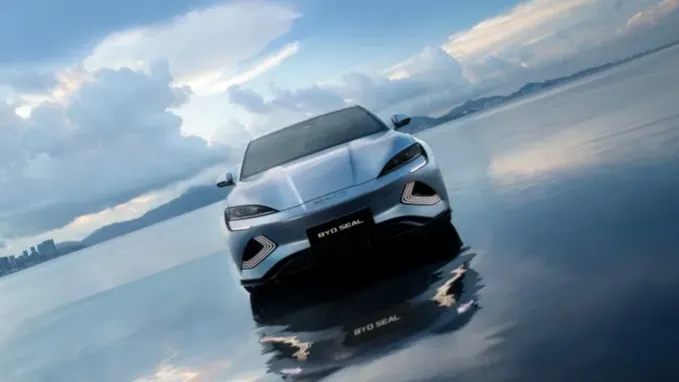
For a Chinese EV to be legally imported and registered as a private vehicle in Canada, the manufacturer must first be registered in Transport Canada's Appendix G Pre-clearance Program — a database of recognized foreign vehicle importers whose facilities and products have been certified as CMVSS-compliant. As of early March 2026, only BYD has registered its passenger car factories with Appendix G for consumer vehicles. Chery, Geely (for its own nameplate), Nio, XPeng, and all other major Chinese passenger car brands remain absent from the registry.
Source: BYD
Even BYD's Appendix G listing — which covers its Shenzhen and Xi'an plants producing the Seal, Dolphin, Atto 3, and Seagull — does not automatically mean those vehicles are available for private purchase. Commercial import permits under the GAC quota are issued to OEMs and their agents, not to individual buyers. A private person in Montreal cannot apply for a shipment permit for a single vehicle; the framework was not designed for retail-level imports.
Advertisement – Continue scrolling for more
Separately, Transport Canada paused new Appendix G intake for passenger vehicles in 2025, meaning Chinese brands that missed that window face a more complex path to certification. They may pursue case-by-case authorization through Transport Canada, but that process requires VIN-specific clearance and is not designed for consumer volumes.
Industry consultant Stephen Beatty, a former Toyota Canada executive, told CBC News that manufacturers without previously certified vehicles may require a year or more to meet Canadian safety standards, pushing many first deliveries to 2027 or later.
The practical upshot for a private buyer today: the path to legally importing a Chinese-market-spec EV into Canada for personal use and registration is, in the vast majority of cases, closed. The commercial quota structure and safety certification requirements together mean that the route to a Chinese EV on Canadian roads runs through authorized dealers — not direct personal import.
Advertisement – Continue scrolling for more
What changes that calculus is manufacturer homologation. Once BYD, Chery, or another brand completes CMVSS certification, establishes a dealer network, and begins retail sales in Canada, consumers will be able to purchase those vehicles through normal channels.
Anyone determined to explore personal import options should contact Transport Canada at 1-800-333-0371 or mvs-sa@tc.gc.ca before taking any step — including before purchasing or shipping a vehicle. Vehicles presented at the border without proper clearance are denied entry and must be exported or destroyed at the importer's expense.
Advertisement – Continue scrolling for more