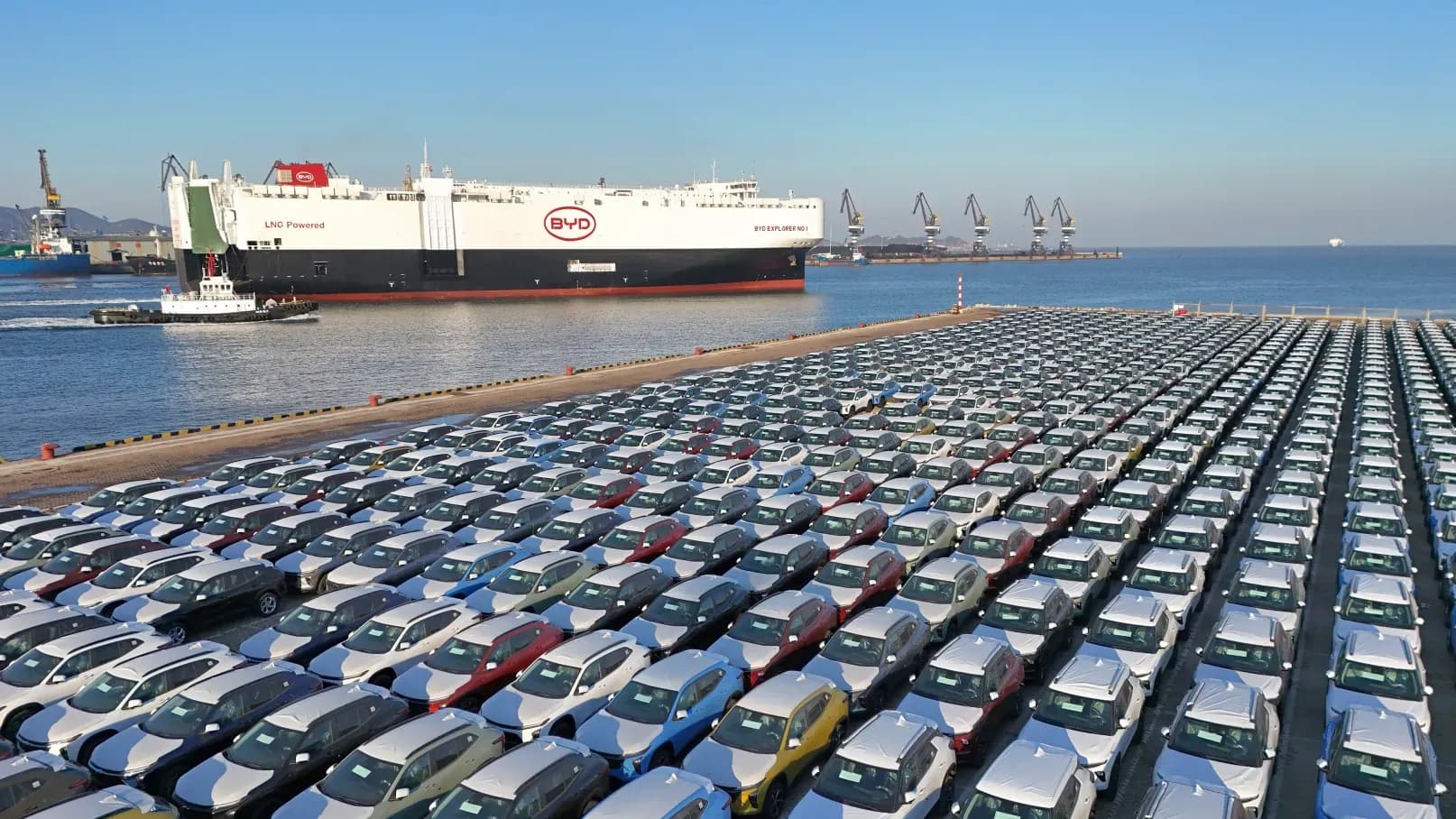
BYD (HKG: 1211) will roll out its Canadian retail network across four provinces in a specific sequence, beginning in Ontario and expanding to British Columbia, Quebec and Alberta, according to a Globe and Mail report citing the dealer consultancy the company has hired.
The provincial rollout marks the first concrete geographic plan from a Chinese automaker since Ottawa cut tariffs on Chinese-built electric vehicles to 6.1 percent in January 2026.
Farid Ahmad, chief executive of Markham, Ontario-based Dealer Solutions Mergers & Acquisitions, told the newspaper that BYD aims to establish 20 dealerships within its first year. Three Greater Toronto Area sites are already under discussion. Vancouver, Montreal and Calgary follow in the plan.
Advertisement – Continue scrolling for more
The tariff reversal under Prime Minister Mark Carney's government permits 49,000 Chinese-built EVs annually at a 6.1 percent duty rate, replacing the 100 percent levy imposed in August 2024. The cap rises to 70,000 vehicles within five years, with more than half of imports expected to carry sticker prices under 35,000 CAD (c. $25,600).
Ontario's selection as the entry point surprised some observers given its weaker EV market. Ontario's zero-emission vehicle share sat at 6.8 percent of new vehicle registrations in 2025, less than half of British Columbia's 18.3 percent and Quebec's 18.5 percent. Quebec alone accounted for 49.3 percent of all Canadian ZEV volume in Q3 2025, according to S&P Global Mobility.
The Greater Toronto Area still anchors the rollout because of its scale. Ontario is Canada's largest automotive market by volume, and the GTA offers the densest pool of potential dealer partners and service infrastructure.
Advertisement – Continue scrolling for more
Analysts have also pointed to unused manufacturing capacity in the province as a consideration, given BYD's stated interest in eventually building vehicles in Canada.
British Columbia and Quebec, the second and third phases of the rollout, deliver the highest-yield EV markets in the country. Quebec led all provinces with 22,225 ZEV registrations in Q3 2025 alone.
British Columbia carries the highest EV adoption rate outside Quebec and benefits from established fast-charging infrastructure along the Pacific coast. Both provinces maintain their own purchase incentive programs, separate from the federal Electric Vehicle Affordability Program.
Advertisement – Continue scrolling for more
Calgary's inclusion is the outlier. Alberta has historically trailed national EV adoption, and its harsh winters have deterred battery-electric uptake.
BYD's second-generation Blade Battery, which the company says can flash-charge from 20 to 97 percent in roughly 12 minutes at -20°C (-4°F), factors into the Alberta push. Tesla (NASDAQ: TSLA) is the only major EV brand with meaningful presence in the province, leaving an opening for a new entrant.
Federal consumer incentives will not apply to any BYD vehicle sold in these provinces. The new Electric Vehicle Affordability Program, which runs from April 1, 2026, to March 31, 2031, is restricted to EVs built in Canada or in countries with which Ottawa holds a free-trade agreement.
Buyers in British Columbia and Quebec may still qualify for provincial rebates depending on the model. BYD has not confirmed its Canadian model lineup. The Atto 3 compact SUV, Seal sedan, Dolphin hatchback and Seagull city car are the most probable launch candidates, given their regulatory approval in other right-hand-drive and left-hand-drive Western markets.
Advertisement – Continue scrolling for more
The January trade deal's sub-35,000 CAD emphasis aligns with the Dolphin and Atto 3 price points seen in Europe and Australia.
Chery is pursuing a parallel Canadian rollout, according to Carscoops, and Geely has also signaled interest. All three brands draw from the same 49,000-unit quota in year one, which means BYD's effective per-dealership volume could fall well short of what a standard Canadian franchise would need to operate sustainably.
Whether the four-province footprint holds once import caps expand will depend on BYD's longer-term manufacturing decision. Executive Vice President Stella Li has told Bloomberg the company is open to building vehicles in Canada or acquiring a rival automaker.
If a plant materializes, which province wins that investment?
Conversion rate: 1 CAD = 0.73 USD as of April 18, 2026
Advertisement – Continue scrolling for more