
Xiaomi Auto on June 11, 2026, published a demonstration video of a home charging robotic arm that autonomously connects and disconnects an EV charging gun — removing any need for the driver to physically handle a cable.
The system mounts to a wall or floor beside a parking space and uses AI vision recognition for sub-millimeter precision when inserting the plug. Once the vehicle parks within reach, the arm locates the charge port, opens any motorized port cover, inserts the connector, and unplugs automatically when the battery reaches full capacity or a pre-set limit. Owners can also trigger or monitor the process remotely through a smartphone.
The unit's housing measures just 152mm wide, making it narrow enough to install alongside vehicles in tight residential garage bays. Xiaomi Auto confirmed the demo was filmed in a real-world setting, stating all showcased functions are production-ready. A Q4 2026 market launch is the stated target, though no pricing has been announced.
Advertisement – Continue scrolling for more
The robotic arm extends Xiaomi Auto's existing home charging lineup, which already includes 7 kW and 11 kW wallbox units and a portable 2.8 kW charge/discharge gun. The 7 kW model runs on 220V single-phase power; the 11 kW version uses 380V three-phase. The robotic arm integrates into Xiaomi's "human-car-home" ecosystem rather than operating as a standalone accessory.
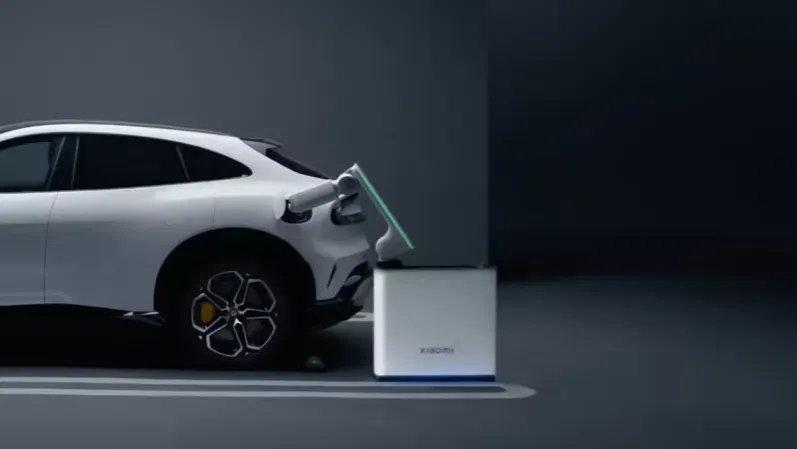
Xiaomi Auto automatic charging gun (Xiaomi)
The concept is not new. Tesla (NASDAQ: TSLA) demonstrated a snake-like robotic charger prototype in August 2015 after Elon Musk teased the idea in late 2014, but the product never reached production and has since been abandoned. Tesla has since pivoted toward wireless charging, acquiring German startup Wiferion in 2023 and designing the Cybercab without a conventional charge port — though wireless charging development for that vehicle has also stalled.
Advertisement – Continue scrolling for more
Several Chinese automakers are pursuing similar solutions. Li Auto tested its own charging robot alongside the i8 pure electric SUV launch. Harmony Intelligent Mobility Alliance (HIMA) demonstrated an automated robotic arm for the Aito M8 electric version last August, using an off-vehicle parking feature combined with a smartphone trigger to open the port and insert the plug. At the 2025 Shanghai Auto Show, Star Charge debuted its "Armstrong" robotic charging system with millimetre-level AI visual guidance and support for GB, EU, and US connector standards through a patented adapter ring.
Xiaomi's approach carries a practical efficiency argument against wireless alternatives. Current SAE J2954-compliant wireless systems operate at 88–93% efficiency under optimal alignment and are capped at 11 kW. A direct plug-in connection via robotic arm maintains roughly 95% efficiency with no power ceiling imposed by the wireless standard — delivering hands-free convenience without the energy losses that inductive charging requires.
Pricing will be the deciding factor in how the product lands. Xiaomi has a track record of competitive pricing on EV accessories, but until figures are released ahead of the Q4 2026 window, the robotic arm remains a well-executed demo rather than a product consumers can plan around.
Advertisement – Continue scrolling for more