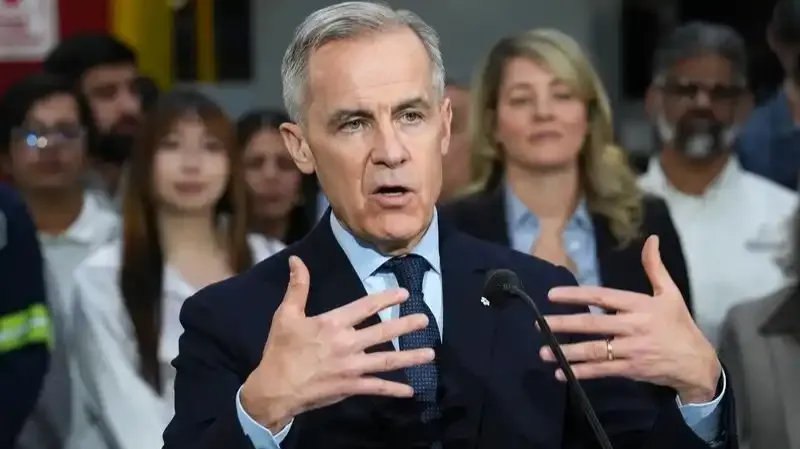
Canada is pursuing joint ventures with Chinese automakers to build electric vehicles in Canada for export to global markets, as Prime Minister Mark Carney moves to diversify the country’s auto sector away from heavy reliance on the United States.
On February 6, 2026, Carney and Industry Minister Mélanie Joly outlined a new Auto Strategy and confirmed talks aimed at establishing Canada–China joint venture assembly plants that would produce electric vehicles for international sales.
Advertisement – Continue scrolling for more
The push follows the signing of the China–Canada Economic and Trade Cooperation Roadmap in January, which included a new arrangement for Chinese EV imports. Under the deal, Canada will allow an annual quota of 49,000 Chinese-made electric vehicles to enter the country at a most-favored-nation tariff rate of 6.1%, removing the previously imposed 100% additional tariff on those vehicles. The quota is set to grow annually.
The agreement restores Chinese EV exports to Canada to levels seen before trade frictions escalated and comes shortly after China and the European Union adopted a “price undertaking” system to replace high anti-subsidy duties on Chinese EVs.

For Ottawa, the policy shift is tied directly to trade diversification and domestic industrial policy. More than 90% of Canadian-made vehicles and 60% of Canadian-made auto parts are currently exported to the U.S., leaving the sector highly exposed to U.S. trade actions.
That exposure increased after the United States imposed a 25% tariff on Canadian vehicles and auto parts last year, accompanied by pressure for higher domestic U.S. vehicle production. General Motors subsequently announced layoffs at Canadian facilities, while Stellantis abandoned plans to restart Jeep production at a plant near Toronto.
Advertisement – Continue scrolling for more
In response, Carney announced a broad incentive package on February 5 to support Canada’s auto industry. Measures include CAD 3 billion from the Strategic Response Fund and up to CAD 100 million from the Regional Tariff Response Initiative to help manufacturers adapt and diversify, alongside tax incentives for zero-emission technology producers.
Canada also introduced a five-year, CAD 2.3 billion EV Affordability Program offering consumer incentives of up to CAD 5,000 for battery electric and fuel cell vehicles and up to CAD 2,500 for plug-in hybrids, subject to a CAD 50,000 transaction price cap. That cap does not apply to Canadian-made EVs and PHEVs, creating a direct incentive to localize production.
Minister Joly said Canada is actively seeking to attract a China–Canada joint venture manufacturing facility. She said major Canadian auto parts suppliers, including Magna International, Linamar, and Martinrea International, already operate in China and could participate in joint venture assembly operations in Canada.
She said these companies could work with Chinese electric vehicle manufacturers to jointly build Canada–China vehicles and export them globally.
Advertisement – Continue scrolling for more
During a visit to China in January, Joly met with representatives from BYD (HKG:1211) and Chery Automobile. She also highlighted QNX, owned by BlackBerry Ltd. as a potential software partner, saying security concerns surrounding Chinese vehicle technology could be addressed through software solutions while maintaining Canadian labor standards.
Prime Minister Carney has framed the strategy as part of a broader realignment of Canada’s trade relationships. During his January visit to China, he described China as a more stable and predictable trade partner than the United States and confirmed that Canada would cancel the earlier 100% additional tariff on imported Chinese EVs.
Carney said the new China–Canada framework is expected to drive joint ventures and investment over the next three years, supporting job creation and strengthening Canada’s electric vehicle supply chain.
Advertisement – Continue scrolling for more
China’s EV sector provides the industrial scale behind the strategy. In 2025, China produced 16.63 million new energy vehicles and sold 16.49 million units, up 29% and 28.2% year on year, respectively. Exports reached 2.62 million units, doubling from the prior year.
BYD, which has operated in Canada since 2013, has established a manufacturing presence in Ontario focused on electric bus assembly and has delivered vehicles to major transit operators, including the Toronto Transit Commission. In 2025, BYD sold 2.26 million pure electric vehicles globally, surpassing Tesla to rank first in annual EV sales, with overseas deliveries exceeding 1.05 million units.
Under Canada’s new rules, imported Chinese EVs within the 49,000-unit quota will not qualify for federal purchase incentives unless they are manufactured in Canada, reinforcing Ottawa’s push for localized production through joint ventures.
Carney said Canada is in discussions with new investors outside the United States and positioned the auto strategy as part of a longer-term effort to reduce economic dependence on a single market.
With tariff relief, investment incentives, and joint venture talks now aligned, the next question is whether Canada can translate policy momentum into factory commitments quickly enough to secure a place in global EV export supply chains.
Advertisement – Continue scrolling for more