On February 1, Li Auto (NASDAQ: LI; HKEX: 2015) reported January 2026 deliveries of 27,668 vehicles, marking a 7.5% year-on-year decline and a 37.46% month-on-month drop. Cumulative deliveries reached 1,567,883 units. The result reflects both seasonal weakness and rising competitive pressure in China’s extended-range SUV market.
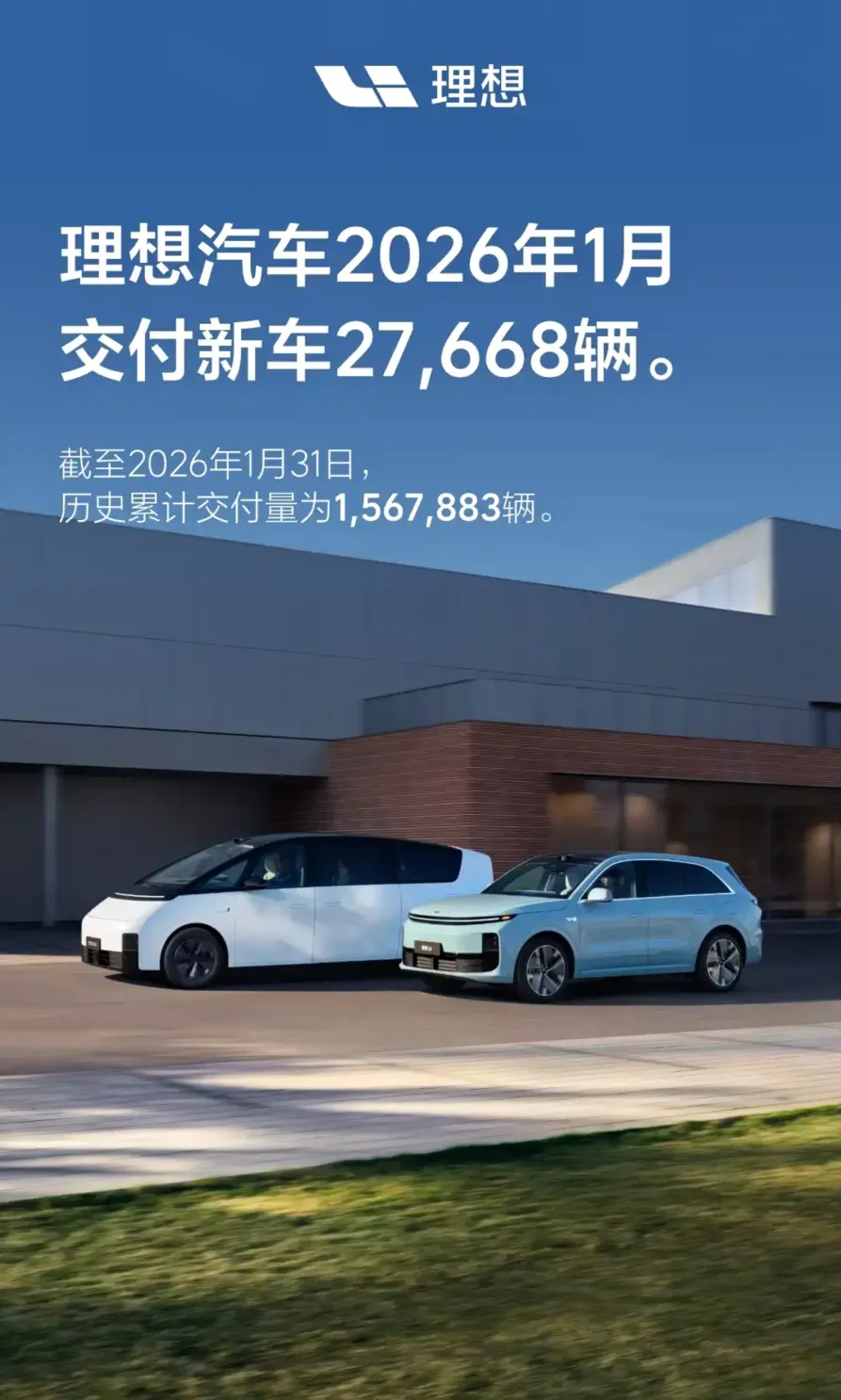
Source: Li Auto
The company delivered 29,927 vehicles in January 2025 and 44,246 vehicles in December 2025, making the January pullback one of its sharpest sequential declines in recent quarters. China’s passenger vehicle retail sales also declined in January, with several leading new-energy vehicle brands, including Leapmotor, HIMA, and Xiaomi Auto, XPeng, and NIO also reporting month-on-month declines.
Advertisement – Continue scrolling for more
Li Auto has been one of the earliest profitable new-energy vehicle startups in China and for an extended period ranked first among new entrants by monthly sales. The company previously published weekly sales rankings to highlight market leadership. That position has become more contested as competition has intensified and more brands have entered the same segments.
For full-year 2025, Li Auto recorded approximately 405,943 cumulative vehicle sales, representing a year-on-year decline of about 19%, and failed to meet its annual sales target of 640,000 vehicles. January 2026 results suggest the company has yet to return to earlier growth momentum.
Extended-range electric vehicles (EREVs) remain central to Li Auto’s lineup. The company built its early success on models such as the Li ONE and the L-series extended-range SUVs, which use electric drive for short trips and switch to a range-extending generator for longer distances. In this configuration, the internal combustion engine does not directly drive the wheels, allowing for consistent driving dynamics across modes.
Advertisement – Continue scrolling for more
The EREV model helped Li Auto achieve rapid growth in earlier phases of the market. However, the extended-range solution is now widely adopted across the industry. Multiple competitors have launched vehicles in the same class as the L-series, with some adopting similar exterior and interior design approaches. The proliferation of comparable models has diluted market share and reduced differentiation.
In January, deliveries were also affected by declining sales of new extended-range models and the company’s i-series pure electric vehicles, which have not yet reached large-scale delivery volumes. As a result, Li Auto did not surpass the 30,000-unit monthly threshold. By contrast, in prior periods, a single model such as the Li L6 sold roughly 25,000 units per month.
Li Auto has stated that its lineup is transitioning to new versions of the L-series, while delivery capacity for the i-series pure electric models is being ramped up. The company has indicated that these changes are intended to stabilize volumes and support a recovery in monthly deliveries.
Advertisement – Continue scrolling for more
Pricing strategy remains a differentiating factor. Li Auto’s lowest-priced new vehicles are currently priced at approximately 250,000 CNY (c. $36,000). This positioning means the company has not fully entered the most aggressive phase of the industry price war. In comparison, competitors such as XPeng (NYSE: XPEV) have introduced models in the 100,000 CNY segment (c. $14,400), increasing pressure at lower price tiers.
The company’s next phase will depend on execution across refreshed L-series models and the scaling of pure electric deliveries, as it seeks to defend share in a market where extended-range powertrains are no longer a differentiator.
Conversion rate: 1 USD = 6.944 CNY as of February 2, 2026
Advertisement – Continue scrolling for more